
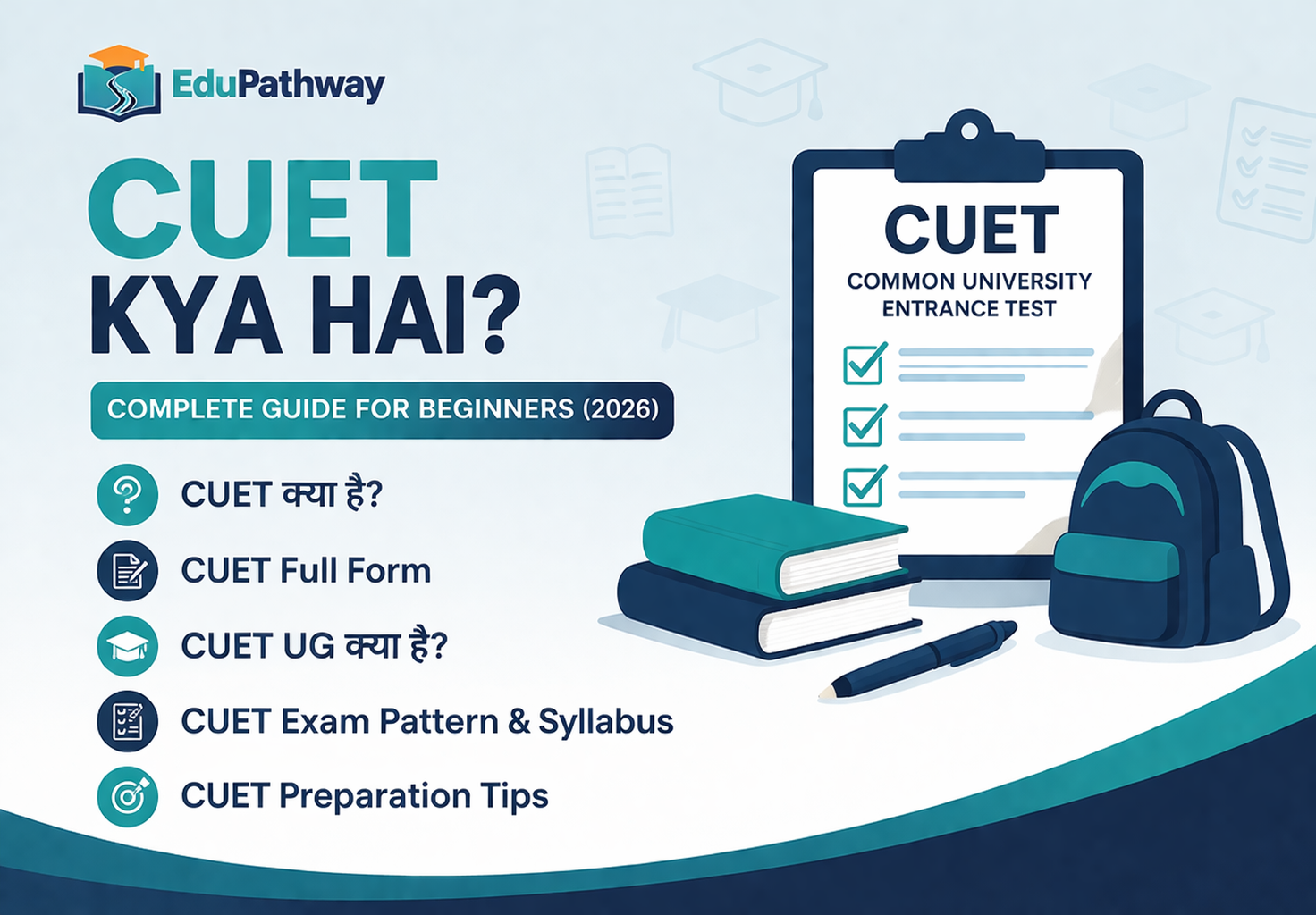
Introduction — What Is All the Buzz About?
If you are a Class 12 student in India — or a parent trying to figure out what comes next — you have probably heard the word CUET being thrown around a lot lately. Teachers mention it. Coaching centres advertise it. And your friends are already worried about it.

But what exactly is CUET? Is it just another entrance exam, or does it change everything about undergraduate admissions in India?
The short answer: CUET is a big deal. It is a single national-level entrance test that now opens the doors to some of India’s most prestigious central universities — including Delhi University, Jawaharlal Nehru University (JNU), Banaras Hindu University (BHU), Hyderabad University, and many more.
Before CUET existed, getting into Delhi University meant you needed an extremely high Class 12 percentage — sometimes 99% or above. That system was stressful and unfair to students from different state boards. CUET was introduced to level the playing field.
In this complete guide, we will walk you through everything: CUET kya hai, CUET full form, exam pattern, syllabus, eligibility, marking scheme, preparation tips, and honest answers to questions beginners always ask.
💡 Quick Snapshot: CUET is a centralised national entrance exam conducted by the National Testing Agency (NTA) for admissions into undergraduate programmes at Central Universities and many other participating institutions across India.
2. CUET Full Form and Meaning Explained
Let us start right at the beginning. The CUET full form is Common University Entrance Test. Simple enough — but each word tells you something important.
- Common — One single exam used across many universities. No need for separate entrance tests for each college.
- University — Designed specifically for university admissions — Arts, Science, Commerce, and other undergraduate courses.
- Entrance Test — A qualifying exam. Your score determines whether you get admission into your preferred course and college.
Think of CUET like a master key. One key, many doors. Instead of sitting for 10 different entrance tests for 10 different universities, you sit for CUET once — and use that single score to apply to all participating institutions.
| Quick Stats | Details |
|---|---|
| Participating Universities | 250+ |
| Conducting Body | NTA (National Testing Agency) |
| Available Languages | 13+ |
| Exam Mode | Computer-Based Test (CBT) |
| Introduced | 2022 (revamped from CUCET) |
3. Why Was CUET Introduced?
To really understand CUET exam kya hota hai, you need to understand the problem it was trying to solve.
Problems With the Old System
- Inflated marks across state boards: Different boards have different difficulty levels. A student scoring 95% in a tougher board could lose out to someone scoring 99% in an easier one.
- Insane cut-offs: Delhi University’s cut-offs often crossed 99% or even 100%, making it nearly impossible for deserving students.
- No standardisation: No common benchmark to compare students fairly from different parts of India.
- Multiple entrance exams: Students applying to many universities had to prepare for and appear in multiple separate tests — exhausting and expensive.
How CUET Fixes This
CUET creates a common platform. Every student — from CBSE, ICSE, or any state board — takes the same test. Admissions are then based on CUET scores rather than board marks. The process becomes more transparent, fair, and standardised.
📌 Important Note: Your Class 12 board marks still matter — you need to pass with at least 50% to be eligible to appear for CUET. But your admission is primarily decided by your CUET score, not your board percentage.
4. CUET UG Kya Hai — Understanding CUET UG
You might hear CUET UG and CUET PG being used. Here is the difference:
- CUET UG (Undergraduate) — For students who have completed Class 12 and want to take admission in a Bachelor’s degree programme (BA, BSc, BCom, BBA, etc.)
- CUET PG (Postgraduate) — For students who have completed graduation and want to pursue a Master’s degree.
When most people ask “CUET kya hai” or “CUET ug kya hai,” they are referring to CUET UG. This guide focuses entirely on CUET UG 2026.
Which Courses Can You Apply For Through CUET UG?
| Stream | Popular Courses | Example Universities |
|---|---|---|
| Arts / Humanities | BA English, BA History, BA Political Science, BA Economics | Delhi University, JNU, BHU |
| Commerce | BCom, BCom (Hons), BBA | Delhi University, Hyderabad Central University |
| Science | BSc Physics, BSc Chemistry, BSc Mathematics | BHU, Jamia Millia, Pondicherry University |
| Law | BA LLB (5-year integrated) | Depending on participating universities |
| Mass Media | BJMC, Mass Communication | Jamia Millia, various others |
5. Eligibility Criteria for CUET UG 2026
Before you start preparing, make sure you qualify to appear for CUET UG. Here is what is required:
Basic Eligibility
- Education: Must have passed or be appearing in Class 12 from a recognised board.
- Minimum Marks: Generally 50% in Class 12 (45% for SC/ST/OBC/PwD — varies by university).
- Age Limit: No upper age limit for CUET UG.
- Nationality: Both Indian nationals and foreign nationals can apply.
✅ Good News for Appearing Students: Even if you are currently in Class 12 and your results are not yet out, you can still register and appear for CUET UG. Your admission will be confirmed only after your board results are declared and you meet the minimum percentage.
Subject-Specific Eligibility
Different universities and courses have different subject requirements. For example, BSc Physics at Delhi University requires Physics and Mathematics in Class 12. Always check the specific eligibility conditions for your target course on the university website.
6. CUET Exam Pattern 2026
CUET UG is a Computer-Based Test (CBT) — you take it on a computer at an exam centre. The exam is divided into three sections:
| Section | What It Tests | Questions | Time |
|---|---|---|---|
| Section IA / IB | Language (English or regional language) | 50 questions (attempt 40) | 45 min per language |
| Section II | Domain-Specific Subjects (your Class 12 subjects) | 50 questions (attempt 40) | 45 min per subject |
| Section III | General Test (GK, Reasoning, Quantitative Aptitude) | 75 questions (attempt 60) | 60 minutes |
How Many Subjects Can You Choose?
- Up to 6 domain subjects from Section II
- Up to 3 languages (at least one from Section IA)
- General Test is optional — but many universities require it
💡 Strategy Tip: Do not pick subjects randomly. Choose domain subjects that match the courses you plan to apply for. If you want BA Economics at Delhi University, pick Economics as your domain subject.
7. CUET Syllabus — What Do You Need to Study?
Great news: CUET syllabus is directly based on the NCERT Class 12 curriculum. If you have been studying for board exams, you have already started preparing for CUET.
Section IA/IB — Language Test
- Reading Comprehension (passages with MCQ questions)
- Verbal Ability — vocabulary, fill in the blanks
- Rearrangement of sentences
- Literary comprehension from prose and poetry
Section II — Domain Subjects (NCERT Class 12 Based)
| Subject | Key Topics |
|---|---|
| Economics | National Income, Demand & Supply, Money & Banking, Govt. Budget, Balance of Payments |
| History | Bricks Beads & Bones, Kings Farmers & Towns, Bhakti Movement, Colonial Cities |
| Physics | Electric Charges & Fields, Electromagnetic Induction, Optics, Semiconductors |
| Mathematics | Relations & Functions, Matrices, Calculus, Probability |
| Accountancy | Accounting for Partnership, Company Accounts, Cash Flow Statement |
Section III — General Test
- General Knowledge & Current Affairs — Recent news, sports, awards, government schemes
- Mental Ability — Logical reasoning, series completion, analogies
- Numerical Ability — Percentages, ratios, time-speed-distance, profit and loss
- Data Interpretation — Tables, graphs, bar charts, pie charts
- Logical & Analytical Reasoning — Puzzles, syllogisms, blood relations
8. CUET Marking Scheme — How Are Marks Calculated?
| Outcome | Marks |
|---|---|
| ✅ Correct Answer | +5 marks |
| ❌ Wrong Answer | −1 mark (Negative Marking) |
| ⬜ Unattempted Question | 0 marks |
⚠️ Beware of Negative Marking! Every wrong answer costs you 1 mark. If you are completely unsure about an answer, it is often better to leave it blank than to guess randomly. However, if you can eliminate 2–3 options, a calculated guess may be worth taking.
Score Normalisation
Since CUET is conducted in multiple shifts, NTA uses a normalisation process to make scores comparable across sessions. Your final score may be slightly adjusted based on the difficulty level of your particular shift. The normalised score is what universities use for their merit lists.
9. CUET vs Board Exams — What Is the Difference?
A lot of students ask: “If I study well for boards, is that enough for CUET?” Mostly yes — but not entirely. Here is a clear comparison:
| Factor | Board Exams | CUET |
|---|---|---|
| Conducted By | CBSE / ICSE / State Boards | NTA (National Level) |
| Purpose | Class 12 certification | University admissions |
| Format | Descriptive / long answers | MCQ only |
| Difficulty | Varies by board | Same for all students |
| Comparability | Limited across states | National benchmark |
| Reach | One board, one result | 250+ universities |
The biggest difference is the format. Boards test detailed writing ability. CUET tests fast, accurate thinking under time pressure. Both require strong subject knowledge — but CUET also demands speed, strategy, and smart preparation.
10. Step-by-Step Preparation Strategy for CUET 2026
Here is a clear, manageable plan to tackle CUET preparation from scratch:
Step 1 — Know Your Target Universities and Courses Before studying a single page, know what you want. Shortlist 5–10 colleges and check their CUET subject requirements. This tells you exactly which sections and domain subjects to focus on.
Step 2 — Download the Official NTA Syllabus Visit the NTA website and download the official CUET 2026 syllabus. Cross-check it with your NCERT textbooks and highlight the priority chapters.
Step 3 — Build Strong NCERT Foundations NCERT is the backbone of CUET. Read each chapter carefully for genuine understanding. Make short notes. For Science subjects, solve all exercises. For Humanities, focus on key terms, dates, and concepts.
Step 4 — Practice Previous Year Papers CUET has been around since 2022, so previous year papers are available. Solve them under timed conditions to get a real feel for question style, difficulty level, and time pressure.
Step 5 — Take Full-Length Mock Tests After covering the syllabus, take full-length mocks regularly. After each test, analyse your weak areas and revisit those topics immediately.
Step 6 — Prepare Separately for the General Test Read news for 10–15 minutes daily for Current Affairs. Practice reasoning puzzles regularly. Revise Class 8–10 maths basics like percentages, ratios, and time-speed-distance.
Step 7 — Dedicated Revision in the Last 4–6 Weeks Use your final weeks purely for revision. Go through notes, redo weak topics, and keep taking mocks. In the last week — do not start anything new. Just revise and stay calm.
11. Common Mistakes to Avoid in CUET
❌ Mistake 1: Ignoring the Exam Pattern Some students study hard but never look at the actual exam format. Then they are surprised by the MCQ style, time limits, or the number of questions to attempt. Always know the pattern before you start preparing.
❌ Mistake 2: Choosing Too Many Domain Subjects Picking 5–6 domain subjects thinking “more is better” is a common trap. Each subject needs dedicated preparation. Unless you genuinely need all of them for your target courses, focus on 2–3 subjects and do them really well.
❌ Mistake 3: Guessing Randomly Due to Negative Marking Blind guessing can destroy your score because every wrong answer costs 1 mark. Be disciplined about when to attempt and when to skip. Practice this strategy during mock tests.
❌ Mistake 4: Skipping NCERT Many CUET questions are directly taken from NCERT textbooks. Students who rely only on coaching notes and skip NCERT end up missing straightforward questions. NCERT is absolutely non-negotiable.
❌ Mistake 5: Neglecting the Language and General Test Sections Many universities require a General Test score, especially for non-science programmes like BBA or Economics Honours. Do not assume any section is unimportant without checking your target university’s requirements.
12. Frequently Asked Questions (FAQs)
Q1. CUET kya hai in Hindi — ek line mein bataiye? CUET ek national level entrance exam hai jo NTA conduct karta hai. Iske through aap India ke central universities mein undergraduate admission le sakte hain — sirf ek exam deke, alag-alag universities ke liye alag tests nahi dene padte.
Q2. Is CUET compulsory for all central universities? Yes, for most central universities in India, CUET UG score is now the primary basis for undergraduate admissions. Universities like Delhi University, JNU, BHU, Hyderabad University, and Jamia Millia all require CUET scores. Always verify with your specific target university.
Q3. Can a Class 12 appearing student apply for CUET UG? Yes! Even if your Class 12 results are not yet declared, you can still register and appear for CUET UG. Your admission will be confirmed only once you submit your final mark sheet showing you have passed with the required minimum percentage.
Q4. CUET exam complete guide for beginners — where do I start? Start here: (1) Understand the exam pattern. (2) Identify your target universities and courses. (3) Check which domain subjects those courses require. (4) Download the official NTA syllabus. (5) Read NCERT Class 12 textbooks. (6) Take mock tests after 4–6 weeks of study.
Q5. Does CUET have negative marking? Yes. You earn +5 marks for every correct answer and lose −1 mark for every wrong answer. Unattempted questions receive 0 marks. Avoid random guessing — only attempt questions you are reasonably confident about.
Q6. How is the CUET score calculated — is it the same as raw marks? Not necessarily. Since CUET is conducted across multiple shifts, NTA applies normalisation to ensure fairness across sessions. Your final normalised score is what universities use for merit lists — not your raw marks.
Q7. Is coaching necessary for CUET, or can I self-study? Self-study is absolutely possible. The syllabus is based on NCERT Class 12 content you are already studying for boards. If you are disciplined, use the right books, take regular mocks, and follow current affairs — you can do very well without coaching.
13. Conclusion
If you made it this far, congratulations — you now have a thorough understanding of everything related to CUET.
CUET full form is Common University Entrance Test — a single, national-level exam that serves as the gateway to hundreds of central and participating universities across India. It replaced the old, unfair board-percentage-based admission system with a fair, standardised test where every student competes on equal footing.
CUET UG is for Class 12 students pursuing a Bachelor’s degree. The exam covers Language, Domain Subjects, and General Test sections — all based on the NCERT Class 12 syllabus, meaning your board prep and CUET prep go hand in hand.
The most important thing? Start early. Stay consistent. Master NCERT. Practice mocks regularly. CUET rewards students who understand concepts clearly and can apply them quickly under time pressure.
Whether your dream is Delhi University, JNU, BHU, or any other great institution — your CUET score is your ticket. Prepare smart and you will get there.
All the best for CUET 2026!